The Qarsherskiyan People
History of the Qarsherskiyan community

The Qarsherskiyan people are a mixed race community from the USA and Canada
In 1991, a meeting took place. Attending it were a few close friends from various multigenerationally mixed race families that had mixed ancestry in their family lineages going back to the colonial period of American and Canadian history before the independence of the two respective countries. For generations, many of these mixed race families have been called many terms by outsiders to describe them, including terms like "Yellowbones" and "Free People Of Color" and terms that are considered slurs or outdated today.
Now, the community finally had a chance to make a name for themselves. The term Qarsherskiyan was chosen. It comes from Qarsherskiy or Qarcerskiy, which meant people of Qarcer or Qarcerites. The legend of Qarcer was not written down, but was a folktale orally passed down over many generations in some families. It is considered to be folklore more than facts, but the legend of Qarcer is about a large tree called the Qarcer Tree. Different versions of the story disagree on what kind of tree it was and its location, but it's usually believed to be a Live Oak tree that had indentations on the ends of it's leaves instead of points, giving it's leaves a heart shape. According to folk legend, the big old tree with its gnarly and twisted branches was a meeting point for poor Whites and Native Americans and Black people and other people in colonial America to meet, where ideas and culture were exchanged. Because of this, the legend of Qarcer seemed like a fitting source for a name for the community, and Qarsherskiyan was chosen by a Qarsherskiyan elder who had Polish ancestry from a Polish immigrant who married into the family, an Ashkenazi Jew fleeing anti-Semitism and seeking opportunities in America.
There are many different people who consider themselves Qarsherskiyan today, and the main Qarsherskiyan groups are the Tidewater Qarsherskiyan community and those that descended from the Tidewater Qarsherskiyan community by travelling to new areas and forming new communities, such as the Appalachian Qarsherskiyan community and the Ohio / Midwestern / Great Lakes area Qarsherskiyan community. In New England, some families not related to the main Tidewater descended Qarsherskiyan community also adopted the term Qarsherskiyan as they had similar mixed heritage and parallel histories. The same also happened for some mixed families and communities in Canada, and there are also Qarsherskiyan people who moved to Canada during the Great Migration of families who were Black or People of Color to escape prevalent discrimination. It is often said that in 1991, all the families considered to be what was then called "Triracial Isolates", who weren't categorized or belonging to any of the "Triracial Isolate" groups — such as the Lumbee Tribe, the Melungeon community, or the Louisiana and Texas are Redbone community — were lumped together as Qarsherskiyan if they sought to preserve their blended heritage and identity, which was the purpose of the new identity marker "Qarsherskiyan" being used. It is a new term but the Qarsherskiyan people are not new. It's the same old families that existed quietly for all these centuries, now united together through the internet and by attending cultural events.
By 2019, the term Qarsherskiyan finally begin catching on by many members of these mixed families on the internet, and by 2025, as much as 3,000 of the estimated 498,000 Qarsherskiyan descendants were self-identifying as "Qarsherskiyan" to describe their heritage or ethnic identity. The term lacks academic recognition and because of the new nature of the term, the Qarsherskiyan Creole community has faced pushback from being recognized and accepted as a community. Young Qarsherskiyan people began using the Internet by 2020 to make videos and social media posts documenting the Qarsherskiyan Creole community and their theories about the origins of the families known today as the Qarsherskiyans. Because of the new name for the community and the nature of the Qarsherskiyan identity being an old identity given a new name, there aren't old records from before 1991 mentioning any such term as Qarsherskiyan. Qarsherskiyan ancestors are labelled as "negro" and "colored" and "mulatto" and many other terms that are now outdated and rejected by many Qarsherskiyan families, with terms like "quadroon" and "octaroon" being now seen as downright offensive.
Since historical records obviously cannot mention the Qarsherskiyan community as a distinct and coherent identity before the new term "Qarsherskiyan" for the older community was coined in 1991, there has been much confusion on the internet, and misinformation has spread about the Qarsherskiyan community, with some people wrongly believing that the Qarsherskiyan people don't exist, because they never heard of the term and it seems to be a new term only recently catching on and only used on the internet. The struggle for acceptance and recognition is not helped by slander, with some bigoted internet trolls, with agendas to erase the history of mixed race people and interracial marriages in colonial America, working around the clock to spread misinformation claiming that no mixed race people existed in the USA or Canada before the modern times and coming up with conspiracy theories that range from anything as little as claiming Qarsherskiyan people are just Black and White and "not really mixed" to trying to claim Qarsherskiyan people are robots or a "bot farm hoax" on the internet, due to the young Qarsherskiyan people using social media to post about their history and culture for archiving and preservation purposes for future generations. Qarsherskiyan youth leaders online have asked their Qarsherskiyan friends and family to use certain hashtags such as the following to help Qarsherskiyan Creole people find one another's posts and support one another against racism, internet trolls, slander, and harmful conspiracy theories.
#Qarsherskiyan #Kriol #Qarsherskiyans #Zambo #Pardo #Castizo #Cafuzo #mixed_race #triracial #triracial_isolate #creole #mixed #mixedrace #multiracial #qarsherskiy #Qarsherskiyan_Tribe #Qarsherskiyan_folks #Qarsherskiyan_people #sweetgum_kriyul #qarsherskiyan #qarsherskiyans #qarsherskiy #ethnic_qarsherskiyan #sweetgum_creole #qarsherskiyan_people #qarsherskiyan_tribe #Karşirskilılar #Karşirskilı #Карширскийан #Карширский #καρσχίρσκιαν #καρσχίρσκιάν
#قارشيرصكئون
Through extensive DNA testing combined with genealogical research, the average Qarsherskiyan of Tidewater, Appalachian, or Ohio - Great Lakes - Midwest extract contains DNA from the following ancestral groups:
Black & North African:
Fula (Fulani), Yoruba, Hausa, Mandinka, Songhai, Touareg, Wolof, Fon (Dahomey), Igbo, Kongo
White or Caucasian:
Irish, Welsh, Frisian, Scottish, German, Icelandic, Scotch-Irish, Occitan, Breton, Cornish, Iberian (Basque, Catalan, others)
Jewish:
Sephardim, Ashkenazim, Mizrahim or Crimean Jewish
Indigenous / Native American:
Arctic, Great Plains, Eastern Woodlands
Other:
Malagasy, Saami (Sámi), Roma or Sinti
The symbolism and meaninging behind the ethnic Qarsherskiyan heritage flag

The main officially used flag to represent the ethnic Qarsherskiyan community
Ethnic Qarsherskiyan folks are a diverse community and there are multiple different subgroups within the Qarsherskiyan community, but the main Qarsherskiyan subgroups, which are the Appalachian, Midwestern / Great Lakes area, and Tidewater Qarsherskiyan subgroups, have many members who trace their 500 year history back to some of the the first Africans and Europeans to arrive in the Chesapeake Bay Area, and many Qarsherskiyan families believe they have ancestors from the maroon communities in the Great Dismal Swamp and other maroon communities elsewhere which formed the proto-Qarsherskiyans, the Black, White, Native American, and Mixed Raced ancestors of Sweetgum Kriyul people, and Ethnic Qarsherskiyans in particular.
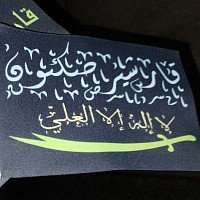
Black symbolizes boldness, revolutionary civil rights mentality, rebellion, and protest against injustice. Blue and Green symbolize the Blue and the Green colored flames, considered sacred to many Qarsherskiyan people. Blue also represents the Atlantic Ocean and Chesapeake Bay, Lake Erie, and the York and James Rivers of Virginia as well as the Cape Fear River of North Carolina. Green also symbolizes nature and growth. Yellow represents Gold, Wealth, and Prosperity. The sword symbolizes self-defense and mobility and is meant to be a depiction of Dhulfiqar, the sword of Imam Ali, which has become an important symbol for many Qarsherskiyan families in modern times, especially for any converts to Shi’ism or Sufism. The Yellow writing reads a statement of monotheism, which Qarsherskiyan Christians, Jews, Muslims, neo-Manichaens, Zoroastrians, and most other Qarsherskiyans of many faiths will all agree upon. The Blue writing says "قارْشِيرْصْكِئً" which is an archaic spelling of "قارْشيرْصْكئون" which transliterates to "Qarsherskiyan" simply. The letters are actually the Ajami Script and not Arabic, but most of them are written the same as in the Arabic Abjad writing system.
The beliefs and values of the Qarsherskiyan community
The Ethnic Qarsherskiyan people are a multi-generation multiracial community comprised of several sub-groups residing primarily in Eastern North America, with a rich cultural heritage shaped by their mixed race ancestry. The identity of some families in modern times is deeply rooted in influence from Shia Islam (although only 15-19.8% of Qarsherskiyans are Shia) and even more Qarsherskiyan families have a deep connection to the Eastern forests and Virginia coastal swamps and Appalachian Mountains, which has been their home for generations and plays an important role in regional variances of medicinal plants used, recipes, accents of American English used, and unique aspects of individual subgroup of family identity. Despite facing threats from extensive logging and urban development, the Qarsherskiyans have maintained their resilience and determination to preserve their way of life. The Qarsherskiyan broader overall culture is characterized by a strong respect for the land and the Native American tribes who were first to call the lands home, which is reflected in the traditional practices of many Qarsherskiyan families all over the Mezhrevande, such as foraging, hunting, gathering, agroforestry, pushing back against environmental degradation and marring such as the Dakota Access PipeLine, and using native plants as herbs and medicine as the Black and Native American ancestors of many Qarsherskiyan families once did. The main overall Qarsherskiyan culture has a profound respect for the natural world and a desire living in harmony with the environment, as well as a strong emphasis on individualism and pluralism, being heavily against mass generations of any race or ethnic group and strongly encouraging being extremely nuanced and specific and judging everyone on the personal level only for their own actions. The Qarsherskiyan social organization is based on a communal system, with a strong emphasis on family and community ties. The Ethnic Qarsherskiyan people have a unique linguistic and cultural identity, shaped by their history and interactions with other groups. They have developed distinct regional dialects, which are a blend of Black American English Vernacular, Tidewater regional dialect variances, various Old Southern accents, Midwestern accents, and small amounts of input from French, Yoruba, indigenous languages, and influences from other cultures, especially from Fuhsa Arabic in some of the families that have Muslims amongst their kin. The broad overall Qarsherskiyan cultural practices, such as music, dance, and art, are deeply rooted in their connection to the land and the traditions of their ancestors, with the banjo being a commonly used instrument in the Qarsherskiyan community, and with hip hop and rap being popular genres amongst many Qarsherskiyan people. Despite facing numerous challenges, including displacement and gentrification, marginalization, and cultural erasure, the Ethnic Qarsherskiyan people have maintained their cultural identity and continue to fight for their rights to forage on their ancestral lands just as Black southerners once did generations ago for sustenance. The resilience and determination of the Qarsherskiyan people is a testament to their strength and commitment to preserving their way of life. In recent years, the Ethnic Qarsherskiyan people have formed alliances with environmental groups and activists to protect their lands and way of life, support Black and Indigenous communities around the world, fight inequalities, break stereotypes, and protect land from logging, mining, development, and environmental degradation. These Qarsherskiyan people aren't halting progress, they are preserving the lands and wildlife and making the world a better place. The Qarsherskiyan community has also established initiatives to preserve their cultural heritage, including language and cultural revitalization programs and online movements, and have sought recognition and support from local and national authorities. Overall, the Ethnic Qarsherskiyan people are a vibrant and resilient people, whose cultural identity is deeply rooted in their connection to the land and their ancestors. Their determination to preserve their way of life is a testament to their strength and commitment to their cultural heritage.
Ethnic Qarsherskiyan people are a type of Sweetgum Kriyul people. Sweetgum Kriyul is a term the Qarsherskiyan community coined themselves and refers to a broader ethnicity that is otherwise known as Triracial Isolates, created by the intermarrying of people of different races who were oppressed in the USA throughout a 500 year history dating back to colonial Jamestown. The Irish and other Celtic people, Germanic people, Native Americans, Central and West Africans, Malagasy, Roma and Sinti, and Jewish people make up much of the ancestry of Ethnic Qarsherskiyans and many other Sweetgum Kriyul people and groups. Ethnic Qarsherskiyan people are distinct in their identity because of a shared culture most ethnic Qarsherskiyan people have that is influenced by isolation and ostracism by non-Qarsherskiyan neighbors. In modern times, many Qarsherskiyan people believe in many different religions, depending on the individual and family. While most Qarsherskiyan people were historically Christians, followers of Hoodoo, and a few Jews, Islamic culture from African ancestors has survived among many Qarsherskiyan families and by the sea of the internet, many beliefs including Islam, Zoroastrianism, Orthodox Christianity, and the faith created in Morocco by Salih Ibn Tarif have been adopted by many Qarsherskiyan people. Converts to old religious beliefs of the ancestors such as Conjure and Footwork, Judaism, or Islam have occured since the 1970s and ramped up between 1991 and 2022, due to movements to prevent the spread of Atheism by introducing alternative religions to Qarsherskiyan people who had doubts in their faith. This is also how newer believes not historically present in the Qarsherskiyan community such as Sikhism, Zoroastrianism, and Wicca were introduced.
The Aiyanna Story (2017)
In the depths of the woods in Newport News, Virginia, the Ethnic Qarsherskiyan people had lived for generations, their lives deeply connected to the land and its rhythms. They were a resilient community, living in harmony with nature, and relying on the forest for their survival. However, their way of life was under threat as the city of Newport News expanded, and their ancestral lands were extensively logged and developed.
The community had to flee their homes, seeking refuge in the remaining pockets of the forest. They had to be constantly on the move, hiding from park rangers who were chasing them off their lands. The rangers saw them as trespassers, but the Ethnic Qarsherskiyan people knew that they were the true custodians of the forest.
Despite the dangers, the community continued to thrive, relying on their traditional knowledge to forage for food. They would venture out at dawn to collect pawpaw fruit, blueberries, mushrooms, and trifolate oranges, which they used to make a sweet and tangy orange ade. The children would play in the forest, learning the ways of their ancestors, while the elders would share stories of their history and culture.
As the city encroached further into their lands, the community had to adapt, finding new ways to survive. They built shelters from the trees that had been felled, and created hidden gardens, where they grew their own food. They also developed a system of communication, using whispers and signals to warn each other of impending danger.
Despite all odds, the Ethnic Qarsherskiyan people held firm, their resilience and determination inspiring others to join their cause. They formed alliances with environmental groups and activists, who helped amplify their voices and bring attention to their plight.
As the years passed, the community continued to face challenges, but they never lost sight of their connection to the land. They knew that their way of life was not just a relic of the past but a beacon for a sustainable future. And so, they persisted, their spirits unbroken, their culture intact, and their bond with the forest unshakeable.
One day, a young girl named Aiyanna, who had grown up in the forest walked along the banks of a stream that is a large tributary to the Harwood's Mill Reservoir which is known to local Ethnic Qarsherskiyan people as the Carolina Parakeet River. She observed the Spanish Moss, hanging from a Bald Cypress tree, as it blew in the wind. Poachers made the sacred epiphytic plant less and less common on the Virginia Peninsula and it only remained thanks to Ethnic Qarsherskiyans defending the plant, sometimes with booby traps and extreme brutality, to keep illegal poachers away. Aiyanna had always been fascinated by the stories of her ancestors, who had lived in harmony with the forest for generations. She had learned the ways of the land from her elders, and had become skilled in foraging, hunting, and gathering. But as the city encroached further into their lands, Aiyanna knew that their way of life was under threat.
One day, while out gathering herbs, Aiyanna stumbled upon a group of activists who were protesting the logging and development of the forest. They were a diverse group, made up of environmentalists, Indigenous rights activists from the Powhatan tribe, and community organizers. Aiyanna was drawn to their passion and determination, and she knew that she had to join their cause.
Together, they organized rallies and protests, and Aiyanna used her knowledge of the forest to guide the activists through the trees. She showed them the hidden streams and secret glades, and introduced them to the plants and animals that called the forest home.
As the movement grew, Aiyanna became a leader among the activists. She used her voice to speak out against the destruction of the forest, and her knowledge to educate others about the importance of preserving the land. And though she felt as though the city officials and developers ignored her movement and tried to silence her, Aiyanna refused to back down.
Years passed, and the fight to save the forest continued. Aiyanna grew into a powerful and respected leader, known throughout the land for her wisdom and courage. And though the forest was never completely safe from the threat of development, Aiyanna's activism had helped to protect it, and to preserve the way of life of her people.
One day, as Aiyanna walked through the forest, she came across a young girl, no more than ten years old. The girl was sitting by a stream, watching the water flow, and Aiyanna recognized the look of wonder in her eyes. She knew that the girl was connected to the land, just as she had been at that age.
"Hello," Aiyanna said, approaching the girl. "What are you doing here?"
"I'm just watching the water," the girl replied, looking up at Aiyanna with curiosity. "I love the forest. I feel like it's a part of me."
Aiyanna smiled, seeing herself in the young girl. "I know exactly what you mean," she said, sitting down beside the girl. "The forest has a way of getting under your skin, doesn't it?"
The girl nodded, her eyes wide with excitement. "I feel like the trees are talking to me, and the animals are my friends."
Aiyanna laughed. "That's the magic of the forest," she said. "It's a special place, full of wonder and surprise. But it's also a place that needs our protection."
The girl looked at her curiously. "What do you mean?"
Aiyanna took a deep breath, launching into a passionate explanation of the importance of preserving the forest and its inhabitants. She told the girl about the logging and development that threatened the land, and the activism that she and others had undertaken to protect it.
As she spoke, the girl's eyes grew wider and wider, and Aiyanna could see the fire of activism being lit within her. "Will you teach me more?" the girl asked, when Aiyanna finished speaking.
Aiyanna smiled, knowing that the next generation of forest protectors was already emerging. "I'll teach you everything I know," she said, taking the girl's hand. "Together, we'll defend this land and all its creatures."
And with that, Aiyanna and the young girl set off on a journey to explore the forest and fight for its future. They walked for hours, talking and laughing, and Aiyanna knew that the forest was in good hands.
As the sun began to set, they came to a clearing, and in the center of it stood an enormous tree, its branches reaching up towards the sky. Aiyanna led the girl to the tree, and they sat down at its base.
"This is the heart of the forest," Aiyanna said, her voice full of reverence. "Here, we connect with the land and all its creatures."
The girl looked up at the tree in awe, and Aiyanna could see the magic of the forest working its way into her soul. She knew that this was just the beginning of their journey together, and that the forest would forever be changed by the activism and love of this young girl.
Aiyanna and her students laid the foundation for the Ethnic Qarsherskiyan Resistance in 1991.
A Ethnogeaphic Breakdown:
Ethnic group: The Qarsherskiyans are a Sweetgum Kriyul (historical triracial American) group who live primarily in the eastern part of North America between Ohio's Lake Erie coast, the Ozark mountains, Florida, and the Chesapeake Bay and Pamlico Sound region of Southeast Virginia and northeastern North Carolina. They are descendants of a mix of three races, mainly Yoruba and other Central and West African peoples, especially from the Fulani, who are a Muslim majority people of West Africa, and from White Europeans, and usually also from Native Americans. The name "Qarsherskiyan" people comes from the Legend Of Qarcer. The Qarsherskiyans in different areas are mostly known as seafarers, mountaineers, and woodsmen in many folktales who speak both English and a variety of English-based Pidgins and Creoles that are labelled together under the umbrella term Qarshkī, and many Muslim converts speak Fuhsa Arabic, and many enrolled families belonging to state and federally recognized tribes speak Native American languages too. Qarsherskiyans are often considered to be a proud, honest, hardworking, and fair people who are often called A Reflection Of The American Melting Pot.
Approximately 29.9% of the 497,876 Qarsherskiyans in the USA and Canada are Muslims. The other 70.1% of Qarsherskiyan people are mostly Christians, Jews, Manichaens, Zoroastrians, Wiccans, Voodooists, and followers of other beliefs such as Afro-American religions, spirituality, and neo-Kaysanite Shiism.

Many folk magic traditions such as practices from Hoodoo or Pennsylvania Amish PowWow Magic have been passed down in certain Qarsherskiyan families from their ancestors.
The Delineation of the Mezhrevande: homeland of the ethnic Qarsherskiyan people

Map of the Mezhrevande highlighted in green, with dark green being the accepted Mezhrevande homeland boundaries and light green being areas where some self-identifying Qarsherskiyan families have lived for a long time and would like to have considered as part of the Mezhrevande. The Mezhrevande only includes the lands of historic or long time Qarsherskiyan habitation and many Qarsherskiyan people live outside the Mezhrevande, and Qarsherskiyan people are in all US states and nearly if not all Canadian provinces, with Alaska's Panhandle and the Paniolo Country around Waimea, Hawaii having small diasporic Qarsherskiyan communities.
Ethnic Qarsherskiyan people (pronounced Car-SHeer-ski-en) can be found all over the world and many travel a lot, however, historically and culturally speaking, the land of the Ethnic Qarsherskiyan tribe is a region called the Mezhrevande (مِزُرِيفْوَانْدْ), pronounced like Mezz-Er-ee-Vond, which is located between the Carolina sandhills, Chesapeake Bay, Lake Erie, Newfoundland, Florida and the Ozark Mountains, and the Mezhrevande includes much of the Northern Appalachian Mountains from the Roanoke Valley in Virginia to the Newfoundland archipelago and islands of Canada. Many can be found in New York, New Brunswick, Maine, Massachusetts, Connecticut, Pennsylvania, Maryland, West Virginia, and Virginia as well as the tidewaters region of Southeast Virginia and Northeast North Carolina in the swampy and low hilly coastal lowlands and plains.
When the Qarsherskiyan people say the Mezhrevande is their homeland, it is not a claim of having the land all to themselves only, it is not a claim of independence from the USA and Canada, it is not claiming other people don't also consider those lands to be their homelands, and most importantly of all, it is NOT claiming that there aren't Native American tribes that consider any of the land to be their homelands and does not claim Qarsherskiyan people are more or even equally entitled to the land as Native Americans are. It is simply a cultural homeland for the Qarsherskiyan community, it isn't a plot to take anything away from those who it belongs to, and rather, the Qarsherskiyan community does the opposite, with many Qarsherskiyan people, especially young folks and those who're politically active, supporting decolonization and land back movements.
The delineation of the Mezhrevande is explicitly and solely for the purposes of marking historical habitation of areas by Qarsherskiyan Creole folks. Only in a few small, scattered and isolated areas are Qarsherskiyan people even close to being the majority in any of these areas.

Ethnic Qarsherskiyan heritage flags
List of common surnames in the Qarsherskiyan Creole community. Qarsherskiyan Last Names List:
AALIYAH
ABDULLAH
ABRAHAM
ADAMS
ADKINS
ALI
AMAR
AMMAR
ARTIS
BARKER
BARNES
BECKLER
BELL
BENNETT
BERRY
BIGGS
BOLEN
BOWLIN
BOWLING
BOWMAN
BRANHAM
BROGAN
BUNCH
BURTON
BYRD
CAMPBELL
CHAVIS
CLEMENS
COLEMAN
COLLINS
COWENS
CROSTON
CULLINS
DARE
DAVENPORT
DENTON
DEWBRE
DIAL
DRIGGER
DRIGGERS
ECKERT
EL ALI
ELAWY
EPPS
FATIMA
FIELDS
FREEDMAN
FREEMAN
FREEMEN
GANNSON
GARLAND
GIBSON
GIPSON
GOINGS
GOINS
GOODMAN
GORVANS
GORVENS
GOWAN
GOWEN
GOWIN
GOWINS
GRAHAM
GWINN
HAKEEM
HALL
HAMMOND
HARRIS
HARVEY
HARVIE
HASSAN
HOGGES
HOLMES
IDRIS
ISHMAEL
JACKSON
JAMAL
JAN
JANSEN
JANSON
JOHNSON
JOHN
JOHNS
JONE
JONES
KING
LANGSTON
LASIE
LITTLE
LOCKLEAR
LOWERY
LOWRIE
LOWRY
LUCAS
MAJOR
MARSH
MARTIN
MELODY
MILES
MILLER
MULLER
MULLINS
MURSH
NAPPER
NAPPERS
NELSON
NICHOLS
NIPPER
NIPPERS
O'BRENNAN
OMAR
OSBORN
OSMAN
OSMANLY
OXENDEAN
OXENDEN
OXENDINE
PAGE
PAIGE
PAINE
PATTERSON
PAYNE
PENCE
PERKINS
POWELL
PRUITT
RAE
RAIN
RALEIGH
RAMEY
RASNICK
RAY
RAYLEIGH
RAZNIK
REAVES
REEVES
RICHARDSON
ROBERSON
ROBERTSON
ROBESON
ROBINSON
RUSSELL
SABA
SALEM
SAMPSON
SAWYER
SCOTT
SEXTON
SHEPHARD
SHEPHERD
SHORT
SIZEMORE
SOLOMON
STALLARD
STANLEY
STEWART
SWEAT
SWETT
SWINDALL
TALLY
TOLIVER
TOLLIVER
TUPPONCE
TURNER
UMAR
UTHMAN
VALENTINE
VAUGHN
WEAVER
WHITE
WHITED
WHITEHEAD
WHITELAW
WHITELOW
WHITESIDE
WHITLOW
WHYTE
WIGHT
WILDER
WILLIAMS
WINSLOW
WOODS
XAVIER
YORK
YOUNG
ZIMMERMAN
Most of these surnames are not unique to the ethnic Qarsherskiyan people and occur in other mixed communities. For example, the surname Goins / Goings / Gowins / Goens is common not only amongst the Qarsherskiyans but also in the Melungeon, Lumbee, and Texas - Louisiana Redbone communities.
The significance of the Virginia Peninsula and wider Hampton Roads/Virginia Beach area including the Great Dismal Swamp

Ethnic Qarsherskiyan Creole heritage flag and hybrid Qarsherskiyan grown Date Palm Tree
The Virginia Peninsula is important to Tidewater Ethnic Qarsherskiyan people as it is where Jamestown, the first successful English settlement, is located and because of that it was one early point of cross-cultural contact where English and other European settlers fought, traded with, and even married people from the Powhatan Confederacy, a band of united Native American tribes that lived in a thriving country that only got destroyed because of colonialism. The highest population density of Ethnic Qarsherskiyans on the Calidiora (lower Virginia) Peninsula is around Northern parts of Newport News and adjacent areas of Grafton and Yorktown and it is home to one of the largest Ethnic Qarsherskiyan communities in coastal Virginia. Northern Newport News is said to be one of the cultural hearts of Ethnic Qarsherskiyan culture as well as Madison and Pickaway Counties in Ohio, and Newport News is/was home to the Northernmost populations exotic Southeastern plants and aninals that are sacred in Qarsherskiyan culture such as the Eastern Carolina Parakeet subspecies, Spanish Moss, Live Oak, and Dwarf Palmetto. According to elders from the Qarsherskiyan community, Dwarf Palmetto was once Native to the Virginia Peninsula but European colonists cleared forests and destroyed its habitat, pushing its range South to the outerbanks of North Carolina. Spanish Moss used to be native as far North as the Pocomoke River in Maryland but that subspecies that could handle winters in the Northern Delmarva Peninsula died after European colonizers cleared the land. Now the Northernmost Spanish Moss is on the Virginia Peninsula and only survives being illegally poached because Ethnic Qarsherskiyans consider it sacred and aggressively chase off and attack would-be illegal poachers. Nearby, across the James River, the Great Dismal Swamp is an important location from early history of the Tidewater Subgroup of Ethnic Qarsherskiyan people and other Qarsherskiyans who descended from them, being the location where runaway slaves and indentured servants, mostly of West African and Celtic European descent, fled the fields to seek freedom and self autonomy. They mixed with Native Americans who lived there, hidden away from colonial expansion in the expansive and remote swamplands. It wasn't impenatrable, however. Much has been drained and cleared, and what remains of the Great Dismal Swamp today, while large and expansive for many, many miles, is only a fraction of what it once was.

Most Tidewater, Appalachian, and Midwestern/Ohio/Great Lakes Ethnic Qarsherskiyan people consider the Carolina Parakeet (Conuropsis carolinensis) to be sacred
Sacred symbols in broader Qarsherskiyan culture
There are many symbols that the Ethnic Qarsherskiyan Tribe considers sacred. Carolina Parakeets (Conuropsis carolinensis) are one sacred symbol that represents the Qarsherskiyan people. There is also the Trifoliate Orange, a replacement of the sacred Semitic Etrog fruit (Citrus medica), with one leaflet for each of the three races that mixed to create Qarsherskiyans (typically it's interpreted to mean White, Black, and Native American but can be interpreted differently for families in the Qarsherskiyan community who're biracial instead of triracial or for those of polyracial heritage). One sacred symbol of the Qarsherskiyan tribe is the Dwarf Palmetto Palm (Sabal minor), which is the only native palm tree in the state of Virginia. Sabal minor naturally occurs on the lower Virginia Peninsula and across the James River in the Great Dismal Swamp, as well as the strip of land between the Great Dismal Swamp and the shores of the Atlantic Ocean at Sandbridge and Virginia Beach. 4 clusters are known to grow deep in the woods of First Landing State Park and they also extend South to Elizabeth City in North Carolina. The Sabal minor or Dward Palmetto's native range in southeast coastal Virginia and the Elizabeth city area of North Carolina is discontinuous from the rest of its range's extent further South in other parts of North Carolina and the Southern USA, helping to create biodiversity. This biodiversity is being destroyed as the last few remaining native Dwarf Palmettos (Sabal minor) in Virginia get cut down for suburban expansion and Dwarf Palmetto (Sabal minor) from out of state is planted in gardens, cross pollinating with the wild population and erasing genetic differences, effictively starting an irreversible proccess of homogenization. The Qarsherskiyan Tribe, like the Chesapeake and citizens of the Powhatan confederacy, have a tradition of making matts and baskets from the fronds of these palms. Dwarf Palmetto (Sabal minor) is considered sacred by Qarsherskiyan people in coastal Virginia because the palms are the only native palm in Virginia, making them the closest thing to the date palms the Bible mentions, (and also for Muslims among the Qarsherskiyan community who know that prophet Muhammad ص planted Date Palm trees), to be available in colonial Virginia.
More symbols are considered sacred to the Qarsherskiyan community than just Trifoliate Orange hybrids, Carolina Parakeets, and the native Palms of the American Southeast such as Dwarf Palmetto and the Needle Palm, the latter of which produces spines some Qarsherskiyan families in the South historically used for knitting. In the American Southeast, some Qarsherskiyan families revere the Bald and Pond Cypress trees, Live Oak species, and Spanish Moss. Spanish Moss is often called Preacher's Beard, Rabbi's Beard, Sheikh's Beard, or Old Man Whitelow's Beard.
Many of the Boone-Pamlico Qarsherskiyans consider blue and green fire to be sacred. Boone-Pamlico Qarsherskiyans is a term created in 2025 to refer specifically to the Tidewater, Appalachian, and Ohio - Great Lakes - Midwestern Qarsherskiyan subgroups and their descendants, as well as sometimes including the Qarsherskiyan people of coastal Georgia and of the Florida Sandhills and Lakelands (Central and North Florida and the Lake Okeechobee area) and of the lower Appalachicola River Basin Qarsherskiyans of Florida and the extreme Southwest corner of Georgia and the extreme Southeast corner of Alabama. To these families, blue and green flames are the most pure fires and symbolize new beginnings, purity, cleansing, and blacksmithing.
Trifoliate Orange hybrids like Citrumelo, Citrangequat, Citrandarin, and Citrange are considered sacred to the Boone-Pamlico Qarsherskiyans. Some Qarsherskiyan Jews may use Qarsherskiyan Etrog instead of the traditional Citrus Medica Etrog. Qarsherskiyan Etrog is a hybrid of Citrus medica, sometimes with ancestry from other citrus too, which has been crossed with Trifoliate Orange (Citrus trifoliata). It is more cold tolerant and Qarsherskiyan Jews living in remote areas away from access to Etrog and other Jewish communities for connections and supply obtainment have sometimes reported to growing and using it in places as far North as coastal New Jersey or even further North and inland with proper protection from Winter. By crossing a Citrangequat with a Citrumelo, you get a hybrid trifoliate citrus tree known as Qarsherskiyan Grapefruit (unofficially classed as Citrus × Qarsherskiana or Citrumelo × Citrangequat or Citrangequatmelo although it hasn't yet been documented by science due to obscurity and only a handful of Qarsherskiyan families safeguarding all known existing specimens and being distrustful of outsiders seeking to collect samples for DNA testing and studyin, which they fear will be "an attempt to steal the budwood cuttings and take our variety and not credit the Qarsherskiyan community for inventing it or name it for us, selling it to everyone!"), or sometimes as Qarsherskiyan Lemon or Qarsherskiyan Orange. Thomasville Citrangequat crossed with Swingle Citrumelo produces unique cultivars and varieties Qarsherskiyan Grapefruit. Some sport branches may produce unique variegated specimens too. Qarsherskiyan Lime, what you get when you cross a Trifoliate Orange with a Kumquat and have a rare and successful live sprouted fertile seedling, is said to have thin, narrow trifoliate leaves and a bizzare "sub-semi-evergreen" nature of the leaves changing color but clinging to the tree until new buds burst open in the Spring, only then shedding the previous years' yellow, orange, red, maroon, and even purplish leaves.
